Who really is James Broadnax?
The media has been portraying James as a tortured artist and a lost soul, someone who was never given a fair shake at life because of an abusive upbringing. But none of this excuses murder. Plenty of children grow up in abusive and broken homes filled with violence and don't become thieves and killers. In fact, many develop a deep empathy for others because they know the pain of growing up in violence. To explain away James Broadnax's actions and behavior because his grandmother beat him is simply placing the blame on someone else.
The Truth
James was 19 at the time. He had the freedom to take the bus, he had the freedom to take the train, he had the freedom to leave whatever abusive environment he was in. But he didn't. He took the train to go "rob rich white folks".
Furthermore, he had the freedom to obtain a gun with his cousin, travel, and murder two men. If he needed money that bad, he could have sold the gun. Instead, he killed two men for a total of $2, and threw away a lifetime of opportunities.
In fact, based on both Broadnax and Cummings' accounts, Matthew and Steve were generous enough to offer them a free recording session at their studio. Broadnax instead decided to circle back to the studio parking lot and shoot both of them dead.
James had the freedom to do whatever he wanted with his life, regardless of his upbringing. But he chose murder. He wanted to be the killer he fantasized about in his raps. If the plan was robbery that night, they could have simply robbed them. Matt and Steve were generous enough that they would gladly give you the shirts off their backs if you asked. But that opportunity was never given to them. According to Broadnax and Cummings, they asked the pair for a cigarette, and when they turned around to get them one, Broadnax opened fire. It wasn't a robbery, it was an execution.
Another sob story you'll hear is that Broadnax tried to turn his life around and do good, but because he didn't have his birth certificate, he couldn't enroll in any programs.
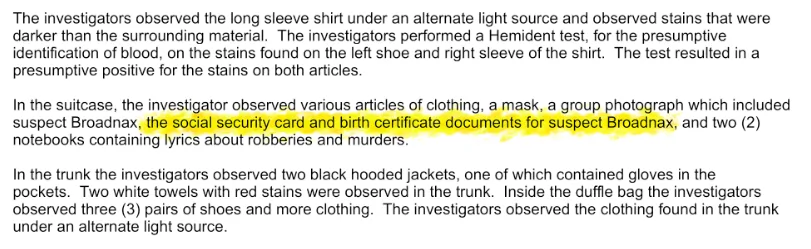
He dropped out of school after the 11th grade, but later enrolled in GED classes, walking four to five miles each way to attend them. When the physical toll forced him to stop, he attempted to enroll in the Job Corps to pursue architecture, but he needed his birth certificate. It was never found....Except he actually did have his birth certificate. It was found in the stolen vehicle of the man he murdered.
A pattern of violence
James Broadnax's history of violence didn't end with the murders of Matthew Butler and Steve Swan. While awaiting trial in Dallas County Jail, he continued to demonstrate a pattern of unprovoked aggression — assaulting a fellow inmate in the recreational area, and striking a different inmate in an unprovoked attack just weeks before his capital murder trial began.
The evidence compiled against him painted a portrait of someone callous, unremorseful, and reveling in his own notoriety. In recorded jail calls made on the same day the jury returned its guilt verdict, Broadnax bragged openly about altercations with inmates and jail staff, boasted that he didn't need a weapon to commit future violence because he could use his bare hands, and threatened both his own defense attorney and a jail maintenance employee.
Most chillingly, he showed no regret for the murders, dismissing the victims' grieving families with contempt, and threatened to kill again if sentenced to life rather than death. When officers searched his cell, they found contraband including a razor blade, a pill, and pornography hidden inside a Bible. And later at his murder trial, he would laugh at the victim’s mother.
But he’s now a changed man!
Murdering two men came far too easily to him. He bragged about it, laughed at the victims’ families in court, and showed a level of cruelty that defies any claim of ordinary human decency. Whatever his upbringing may have been, he lived long enough within society to understand the difference between right and wrong, between good and evil. His actions suggest someone deeply manipulative, capable of masking his true nature when it serves his interests, much like the friendly facade he reportedly presented to Matthew and Steve before killing them. Enrolling in a handful of leadership programs while incarcerated does not, by itself, prove genuine transformation. When someone can take lives so casually, boast about it, and continue displaying that same callousness long after the murders, it raises serious questions about remorse, empathy, and rehabilitation. The concern is not simply what he has said since, but what his actions have already revealed.